
Socratic Questioning 1:
Helping Students Think Deeper
Why Is Socratic Questioning Important?
Socratic Questioning helps teachers understand how students think, not just whether their answers are correct. By asking follow-up questions, teachers can identify misunderstandings and help students develop a clearer understanding of a topic.
It also offers several benefits for students. First, it develops critical thinking by encouraging students to examine information, evaluate evidence, and consider different possibilities. Second, it supports deeper learning because students explore why something happens instead of simply memorizing facts. Third, it builds communication and collaboration skills as students share ideas, listen to others, and discuss different opinions.
Socratic Questioning also encourages independent learning. Over time, students learn to question their own ideas, check their evidence, and reflect on their understanding. These skills help them become more confident in solving problems and making decisions.
These ideas highlight why questioning is valuable in teaching. Students need opportunities not only to receive information but also to explain, explore, and apply what they learn.
How Can Teachers Use Socratic Questioning?
Teachers can use Socratic Questioning in everyday lessons without changing their entire teaching approach. The key is to ask follow-up questions that encourage students to explain their ideas, give reasons, and think about different possibilities.
For example, in a science lesson, a student says, “Plants need sunlight to grow.” Instead of immediately giving an explanation, the teacher asks, “Why do plants need sunlight?” and “What might happen if a plant receives water but no sunlight?”
Teachers can use Socratic Questioning to encourage students to think deeply, reflect on their ideas, and explain their reasoning. They might ask, “Why do you think that?”, “What makes you believe it is true?”, or “Could there be another way to look at it?” Teachers can choose different types of Socratic Questioning depending on the purpose of the discussion and the kind of thinking they want to encourage in students.
Six Stages of Socratic Questioning
1. Clarify Thinking & Understanding
These questions help students explain what they mean and make their ideas clearer.
Examples include “What do you mean by that?”, “Can you explain your answer in another way?” and “Can you give an example?”
2. Challenge Assumptions
These questions help students recognize what they believe to be true without necessarily checking it.
Examples include “Why do you think that is true?”, “Are you assuming something?” and “Is that always the case?”
3. Explore Reasons and Evidence
These questions encourage students to support their answers with facts, examples, observations, or information from a text.
Examples include “What makes you think so?”, “What evidence supports your answer?” and “Where did you find that information?”
4. Consider Alternate Prospective
These questions help students consider other opinions and possible explanations.
Examples include “Could there be another explanation?”, “What might someone who disagrees say?” and “How might another person see this situation?”
5. Discover Sequences
These questions encourage students to think about what might happen as a result of an idea or decision.
Examples include “What might happen next?”, “What would happen if everyone did this?” and “What could happen if your solution does not work?”
6. Question the Question
These questions help students understand why a question matters and identify what they still need to investigate.
Examples include “Why is this question important?”, “What do we need to find out first?” and “What other questions should we ask?”
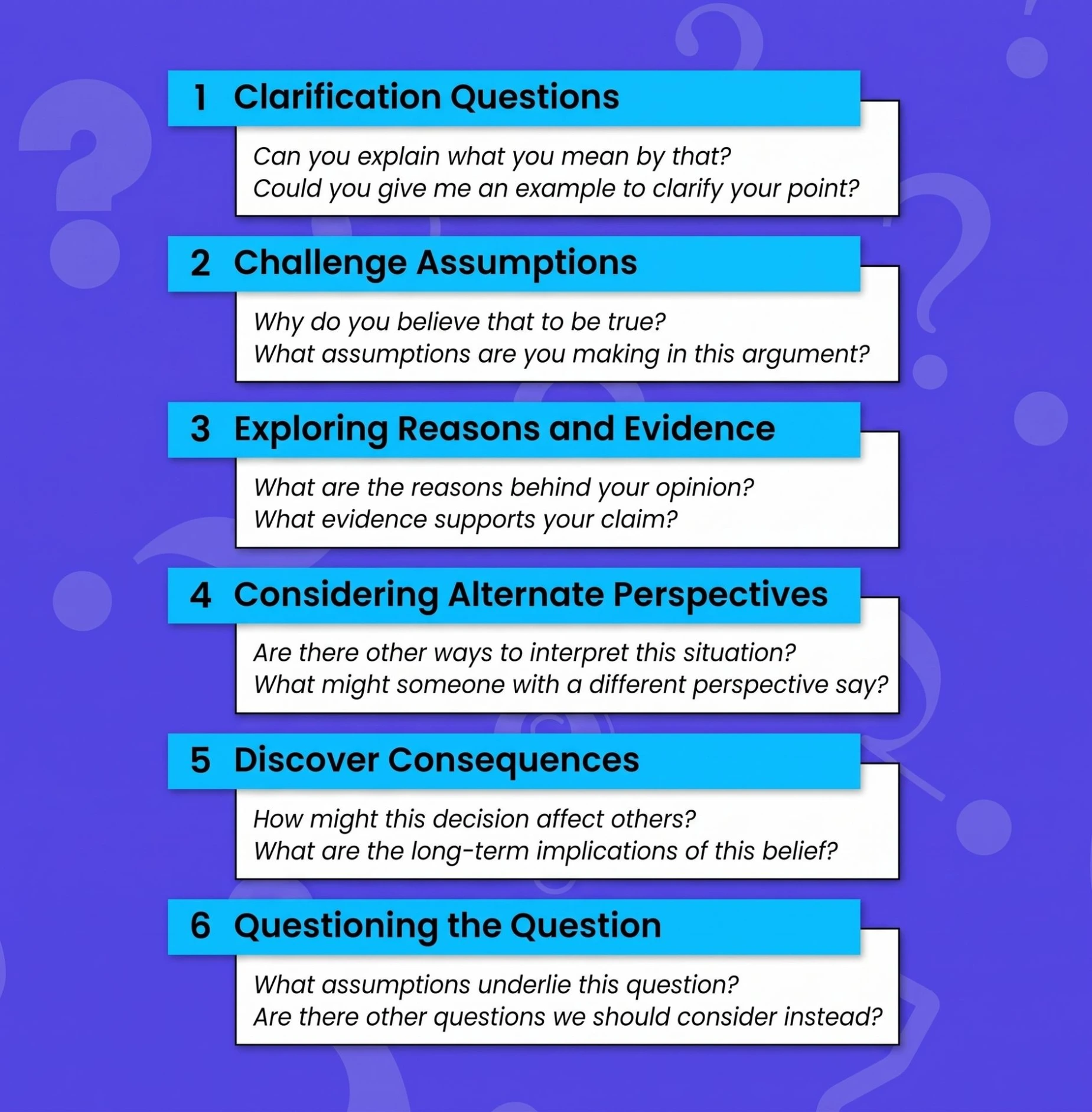
Teachers do not need to use all six types in every lesson. They can choose the questions that best match their learning objectives and students' responses. The aim is to encourage meaningful thinking, not simply to ask as many questions as possible.
Conclusion
Socratic Questioning is a practical approach that helps students develop critical thinking, deeper understanding, communication skills, and independence. Inspired by Socrates, it encourages students to move beyond memorizing information and learn to explain, question, and evaluate their ideas.
Sometimes, a simple question can make a big difference. Instead of immediately giving students the answer, try asking, “What makes you think so?”
Curious about how Socratic Questioning is implemented in practice? Stay tuned for Chapter II, where we’ll explore how it works!